Fujifilm X-E1 Black
The 16.3MP APS-C X-Trans CMOS sensor and EXR processor deliver sharp, true-to-life color without an optical low-pass filter, housed in a classic magnesium alloy body. The 2.36M-dot OLED electronic viewfinder and built-in film simulation modes offer a tactile, film-like shooting experience at a budget-friendly used price. This camera is best for stills photographers who prioritize analog controls and image character over modern video features or fast autofocus.

No current retailer price


Snapshot
The 30-Second Version
A vintage charmer with a killer sensor and frustratingly slow autofocus, now cheaper than it used to be. Buy it for the Fuji magic, not for the specs.
Pros & Cons
Pros
- Gorgeous X-Trans sensor with beautiful color and detail 86th
- Tactile manual dials make shooting feel intentional 85th
- Compact, retro body that's a joy to carry 80th
- Raw shooting with in-camera conversion is handy 75th
- Lower pricing makes it an easy second body for Fuji owners
Cons
- Autofocus is slow and unreliable in low light
- Fixed 2.8-inch LCD feels cramped and dated
- No in-body stabilization
- Video is barely usable by modern standards
- Used bodies vary a lot in condition
What owners think
The Word on the Street
How owner sentiment changed over time
ExclusiveBased on when customers actually wrote their reviews - so you can see whether early praise held up.
20 written reviews, Mar 2014 – Jun 2025: 3 happy, 1 mixed, 16 without stars
Across all 153 store ratings: 4.5★. Most owners rate without writing a review. The chart counts the 20 written reviews.
Each dot is one written review, in the month it was written. Happy = 4-5★, mixed = 3★, unhappy = 1-2★.
The proof
Performance
The sensor is the star here. That 16.3MP X-Trans CMOS sits in the 75th percentile for our database, which is wild for a camera this old. It punches way above its weight for stills, especially if you love that Fuji color science. But the autofocus is a weak spot, landing in the 36th percentile. It hunts in low light and feels sluggish next to anything modern. The burst rate is also mediocre at 6fps, and video is basically an afterthought at 1080p/24fps.
Specifications
Full Specifications
Sensor
| Type | X-Trans CMOS |
| Size | aps-c |
| Megapixels | 16.3 MP |
| ISO Range | 100 |
| Processor | EXR Processing Pro |
Autofocus
| Eye AF | No |
| Animal AF | No |
| Subject Detection | No |
Shooting
| Burst (Mechanical) | 6 |
| Electronic Shutter | No |
Video
| Max Resolution | 1080p |
| 1080p FPS | 24 |
| 10-bit | No |
| Log Profile | No |
| RAW Video | No |
Display & EVF
| Screen Size | 2.8" |
| Touchscreen | No |
| Articulating | No |
| EVF Resolution | 2.36 M dots |
Build
| Weather Sealed | No |
| Weight | 0.9 kg / 1.9 lbs |
Connectivity
| Wi-Fi | No |
| Bluetooth | No |
| Hot Shoe | No |
vs Competition
Our ranking puts the X-E1 up against the Panasonic Lumix G9 II, Sony Alpha a6700 and Nikon Z 6II, and it is not a fair fight on paper. Autofocus at the 36th percentile, 6fps burst, 1080p/24fps video and no in-body stabilization leave it far behind anything current in that group. Where it still holds ground is the sensor: the 16.3MP X-Trans CMOS sits in the 75th percentile in our database, which is remarkable for a 2012 body, and owners keep coming back to that color rendering. The compact, dial-driven shooting experience is the other thing those cameras do not replicate. If you want speed, tracking or usable video, buy from the current top five instead. If you want the older Fuji look for the least money, the X-E1 at the bottom of its price range is the point of it.
| Spec | Fujifilm X-E1 | Sony Alpha a7R VI | Nikon Z8 | Panasonic Lumix G9 II | OM System OM-1 Mark II | Canon EOS R6 Mark III |
|---|---|---|---|---|---|---|
| Type | mirrorless | mirrorless | mirrorless | mirrorless | mirrorless | mirrorless |
| Sensor | 16.3MP aps-c | 66.8MP full-frame | 45.7MP full-frame | 25.2MP micro-four-thirds | 20.4MP micro-four-thirds | 32.5MP full-frame |
| AF Points | - | 759 | 493 | 779 | 1053 | 1053 |
| Burst FPS | 6 | 30 | 30 | 75 | 120 | 40 |
| Video | 1080p | 8K @120fps | 8K @120fps | 4K @120fps | 4K @60fps | 6K @120fps |
| IBIS | false | true | true | true | true | true |
| Weather Sealed | false | true | true | true | true | true |
| Weight (g) | 862 | 622 | 820 | 575 | 511 | 608 |
| Compare | Compare | Compare | Compare | Compare |
| Product | AF | EVF | Build | Burst | Video | Sensor | Battery | Display | User Sentiment | Connectivity | Social Proof | Affordability | Stabilization |
|---|---|---|---|---|---|---|---|---|---|---|---|---|---|
| Fujifilm X-E1 | 37.3 | 85.5 | 84.7 | 60.8 | 1.1 | 75.3 | 46.1 | 27.5 | 18.3 | 14.3 | 80.4 | 58 | 34.3 |
| Sony Alpha a7R VI Compare | 96.5 | 98.9 | 94.5 | 88 | 98.9 | 80.9 | 96.6 | 97.8 | 95.4 | 95.4 | 97.3 | 13.3 | 99.5 |
| Nikon Z8 Compare | 92.8 | 90.6 | 97.4 | 94.8 | 98.4 | 67.6 | 88.9 | 97.5 | 85.4 | 95.4 | 97.3 | 15.2 | 87.5 |
| Panasonic Lumix G9 II Compare | 97.7 | 90.3 | 93.4 | 96 | 97.3 | 59.7 | 90.3 | 96.9 | 95.4 | 95.4 | 86.2 | 30.1 | 87.5 |
| OM System OM-1 Mark II Compare | 98.7 | 99.8 | 92.8 | 99.4 | 83.5 | 46.7 | 95.3 | 95.6 | 85.4 | 95.4 | 86.2 | 28 | 99.5 |
| Canon EOS R6 Mark III Compare | 98.7 | 89.9 | 94 | 90.8 | 89.5 | 62.1 | 96.9 | 95.6 | 69.3 | 95.4 | 92.2 | 18.8 | 99.5 |
Price
Value & Pricing
The price has come down, and that changes the math. We track this body across stores and it now sits between $459 USD and $899 USD, well below where it used to hover around $700 USD. At the bottom of that range it stops being a collector's indulgence and starts looking like a cheap way into Fuji color, especially if you already own X-mount glass. The top end is still hard to justify for a body with autofocus in the 36th percentile. Owner sentiment in our data lands at 72 out of 100, which fits: people who buy it for the sensor and the dials are happy, people who expect modern responsiveness are not. Shop the low end, check condition carefully, and treat it as a second body rather than your only camera.
Read more
Overview
The Fujifilm X-E1 is a camera you buy with your heart, not your spec sheet. It's a 16.3MP APS-C mirrorless body from 2012 that still turns heads because of that X-Trans sensor and the gorgeous, tactile dials. But let's be real: by today's standards, this thing is a slow, quirky vintage piece. If you want a modern hybrid shooter, look elsewhere. If you want a fun, film-like experience and don't mind working for the shot, it's a charmer.
Common Questions
Q: Is the X-E1 good for beginners?
Not really. The slow autofocus and dated menu system will frustrate someone learning the ropes. The Sony Alpha a6700 is a far friendlier starting point if you want something current.
Q: Can I shoot video with the X-E1?
Technically yes, 1080p at 24fps. But there's no stabilization, the autofocus is unreliable, and the fixed screen makes it a pain. Use your phone for video.
Q: Does the X-E1 have image stabilization?
Nope. You'll need stabilized lenses or steady hands. Fuji's OIS lenses help, but the body itself offers zero stabilization.
Who Should Skip This
If you're looking for a fast, modern hybrid camera for video or action, this isn't it. The Sony Alpha a6700 or Panasonic Lumix G9 II will serve you far better. The X-E1 is for people who already love Fuji's older X-Trans sensors and want a compact, dial-driven second body.
Verdict
The X-E1 is a flawed gem. The sensor is lovely, the build is charming, and the dials are a tactile dream. But the autofocus, fixed screen, and lack of stabilization still make it a frustrating daily driver right now. The saving grace is the price: at the low end of its current range it is a much easier recommendation than it was. Owners rate it 72 out of 100 in our data, and that feels about right. Buy it if you know exactly what you're getting into and you value character over convenience.
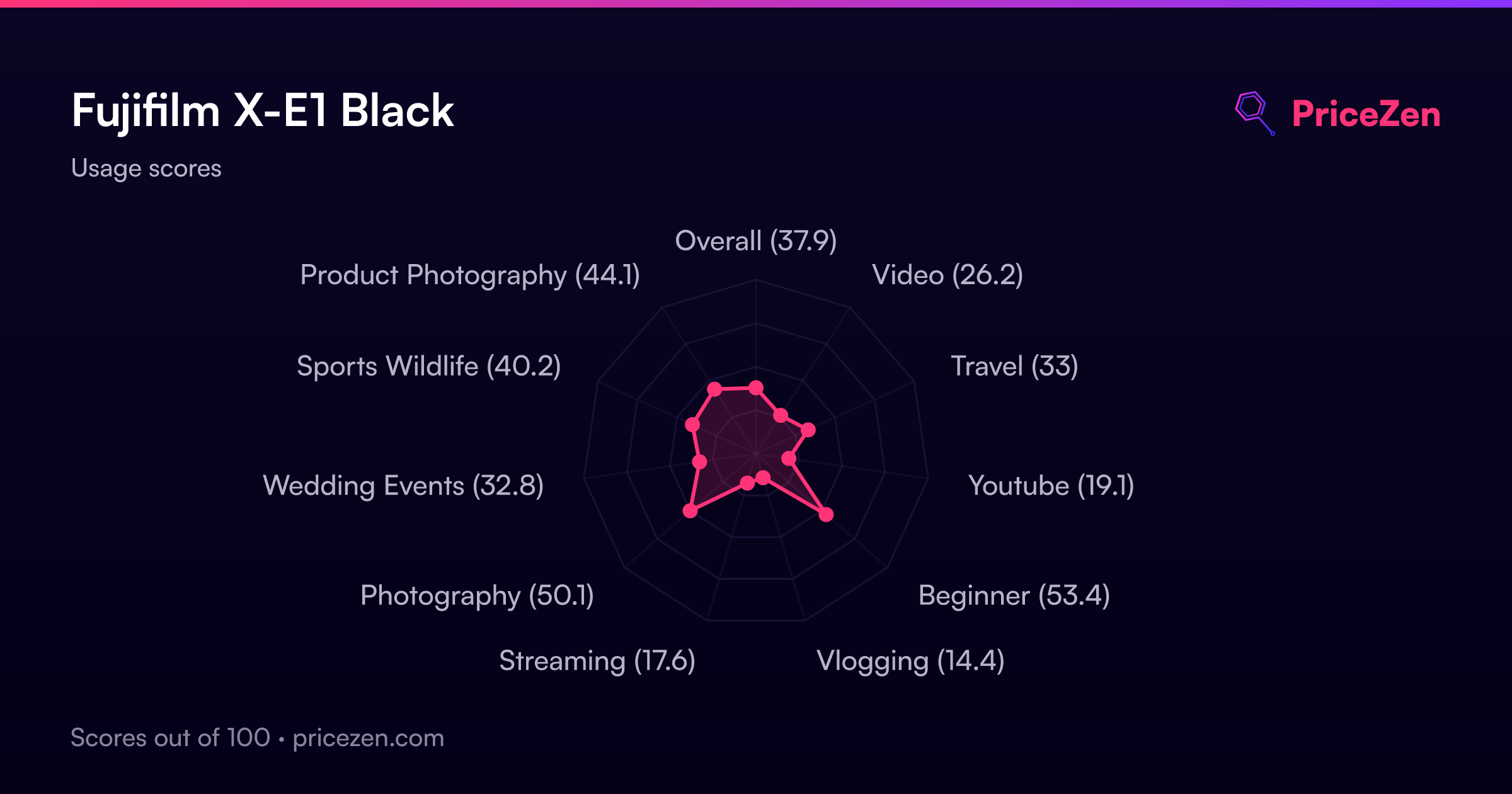
Usage Scores
- Overall37.9
- Video26.2
- Travel33
- Youtube19.1
- Beginner53.4
- Vlogging14.4
- Streaming17.6
- Photography50.1
- Wedding Events32.8
- Sports Wildlife40.2
- Product Photography44.1