Nikon Z8 Black 2023
The 45.7MP stacked CMOS sensor delivers 120fps burst shooting and 8K video with N-RAW and ProRes 422 HQ recording, while the 5-stop IBIS and weather sealing support demanding shoots. The included FTZ II adapter expands lens options to F-mount glass, and the ISO range to 102400 handles low light. Best for wedding and event photographers who need fast, reliable stills and high-resolution video in one body.

No current retailer price











Snapshot
The 30-Second Version
Nikon shrunk the Z9 into the Z8, keeping the stacked 45.7MP sensor, 120fps burst, and class-leading 8K video. Battery life and weight hold it back for travel, but it's an absolute monster for sports, wildlife, and video work. Prices range from $3,380 to $7,230, so shop smart. If you want one camera to rule them all, this is it.
Pros & Cons
Pros
- Blistering 120fps burst mode leaves every other mirrorless in the dust 98th
- Video specs that rival dedicated cinema cameras, including internal 8K/60p RAW 97th
- Best-in-class build quality with full weather sealing, feels like a tank 97th
- Zero-blackout EVF with 3.7M dots makes action tracking a joy 97th
- AF system sticks to eyes and faces like glue, even in dim light
Cons
- Battery life of 340 shots means you'll need spares for a full day
- At nearly 2kg with the kit lens, it's a workout for travel or street shooting
- Travel score of 72.2 reflects the bulk and battery anxiety
- Price spread is wild, from $3,380 to over $7,200 depending on bundle
- 45.7MP sensor is great, but some rivals now push beyond 50MP
What owners think
The Word on the Street
How owner sentiment changed over time
ExclusiveBased on when customers actually wrote their reviews - so you can see whether early praise held up.
Owners are as happy as early on: 100% lately, 95% in Jan 2019 – Jun 2023
Across all 1,594 store ratings: 4.8★. Most owners rate without writing a review. The chart counts the 335 written reviews with stars and their own date.
20 reviews from months with approximate dates (the day we first saw a review) are left out of the trend.
21 written reviews without stars are left out of the trend.
Show the numbers
| Period | Reviews | Happy | Mixed | Unhappy | Happy share |
|---|---|---|---|---|---|
| Jan 2019 – Jun 2023 | 19 | 18 | 1 | 0 | 95% |
| Jul – Sep 2023 | 17 | 14 | 0 | 3 | 82% |
| Oct – Dec 2023 | 25 | 25 | 0 | 0 | 100% |
| Jan – Mar 2024 | 83 | 83 | 0 | 0 | 100% |
| Apr – Jun 2024 | 26 | 25 | 0 | 1 | 96% |
| Jul – Sep 2024 | 12 | 12 | 0 | 0 | 100% |
| Oct – Dec 2024 | 19 | 19 | 0 | 0 | 100% |
| Jan – Mar 2025 | 12 | 12 | 0 | 0 | 100% |
| Apr – Jun 2025 | 23 | 22 | 0 | 1 | 96% |
| Jul – Sep 2025 | 16 | 16 | 0 | 0 | 100% |
| Oct – Dec 2025 | 13 | 13 | 0 | 0 | 100% |
| Jan – Mar 2026 | 13 | 13 | 0 | 0 | 100% |
| Apr – Jun 2026 | 16 | 16 | 0 | 0 | 100% |
| Jul – Sep 2026 | 29 | 27 | 1 | 1 | 93% |
| Oct – Nov 2026 | 12 | 12 | 0 | 0 | 100% |
- Oct – Dec 202612 of 12 happy
Buyers upgrading from D850 or Z7II praise the Z8's autofocus, IBIS, and image quality. One mentions retailer trust for honoring price. All reviews are five-star with high enthusiasm.
- Autofocus is a major upgrade, especially for tracking moving subjects like children and events.
- Image quality and low-light performance are exceptional, with sharp detail and dynamic range.
- IBIS is valued, particularly by older users, for stability.
- Retailer trust: B&H honored a price despite manufacturer increase, praised as stand-up.
- Jul – Sep 202627 of 29 happy
Buyers in Q3 2026 praised the Z8's autofocus, image quality, and performance, especially for wildlife and action. Some noted a steep learning curve, missing manual, and minor issues like joystick drift and bracketing glitches.
- Autofocus and speed are standout features, with users noting fast focus, 20fps bursts, and excellent eye detection for wildlife and air shows.
- Image quality is highly praised, with sharp details, great color, and bokeh, often exceeding expectations compared to DSLR predecessors.
- Learning curve is steep for some, especially those new to mirrorless, but manageable; a few wished for a printed reference guide.
- Minor defects reported: joystick drift and bracketing shots being replaced by previous ones, with Nikon researching the latter.
- Apr – Jun 202630 of 30 happy · 9 without stars
Buyers praise the Z8's autofocus, image quality, and ergonomics, often upgrading from DSLRs. Some report high noise at low ISO and battery life concerns.
- Autofocus is fast and accurate, especially for wildlife and sports, with subject detection being a game-changer.
- Image quality is excellent with high resolution, dynamic range, and low-light performance, though one user disagrees.
- Ergonomics and build are praised; camera feels sturdy, comfortable, and well-designed for long shoots.
- Battery life is a common complaint; users report needing multiple batteries per outing and quick sleep mode.
- Jan – Mar 202613 of 13 happy · 14 without stars
Reviewers praise the Z8 for excellent image quality, fast autofocus, and strong performance in bird/wildlife photography. Some note autofocus struggles in extreme backlight, a useless included bag, and an early recall of strap lugs.
- Excellent autofocus speed and reliability for wildlife and sports.
- Outstanding image quality and smooth upgrade from older Nikon models.
- Autofocus can miss or lag in very bright backlit conditions.
- Early recall for loose strap lugs; included bag is too small for camera.
- Oct – Dec 202513 of 13 happy
Buyers in Q4 2025 praise the Z8 for its advanced features, image quality, and handling, though some note a learning curve and minor flash sync concerns.
- Excellent image quality and performance, often called superior to DSLR predecessors.
- Appreciated features: electronic shutter, IBIS, EVF zoom for manual focus, and compact design.
- Flash sync speed limited to 1/200th; occasional triggering glitch reported.
- Learning curve for settings noted but manageable with online tutorials.
- Jul – Sep 202516 of 16 happy · 2 without stars
Buyers praise Z8's sharp images, fast autofocus, and great sensor, but note higher weight and battery life concerns; one refurbished unit complaint.
- Excellent image quality, sharpness, and dynamic range from stacked sensor.
- Fast, accurate autofocus great for sports, birds, and people.
- Battery life is less than optimal; extra battery recommended.
- One unit sold as 'Renewed' was refurbished in opened box, not as expected.
- Apr – Jun 202522 of 23 happy
All eight reviews are overwhelmingly positive, praising the camera's image quality, ergonomics, and compatibility with existing Nikon gear. Buyers highly recommend the Z8, especially for wildlife and low light.
- Camera quality is excellent—great sensor, ergonomics, and low-light performance.
- Compatibility with D series batteries and SD cards is highly valued.
- The camera is lighter than the Z9, making it easy to carry and use.
- Great service and fast order fulfillment from Adorama.
- Oct – Dec 202419 of 19 happy
Buyers praise the Z8's autofocus, resolution, and value over older models, but note a learning curve, short battery life, and some video overheating concerns.
- Autofocus is excellent, especially for birds and action; huge upgrade from older DSLRs.
- Video autofocus and overheating issues noted but can be improved with specific cards and settings.
- Complex controls and low-resolution viewfinder make fine focus difficult for beginners.
- Battery life is short; carrying a spare is required for extended shooting.
- Apr – Jun 202425 of 26 happy · 1 without stars
Buyers praised the Z8 as a powerful, lightweight professional camera with great autofocus, image quality, and video features. Most were highly satisfied, noting it as a worthy alternative to the Z9.
- Image quality, video specs (8K, 4K120, N-Log), and autofocus performance are top-notch.
- Ergonomics and weight are well-regarded, especially compared to bulkier professional bodies.
- No underexposure issue seen in some Z9 units; improved metering or firmware noted.
- Overall strong recommendation from longtime Nikon shooters; high value for money.
- Jan – Mar 202483 of 83 happy · 1 without stars
Buyers love the Z8's autofocus, build, and handling; a small number report menu complexity, poor documentation, and bundled accessories.
- AF is fast, accurate, and greatly improved especially with firmware 2.0 bird/animal detection.
- The camera is well-built, lighter than D850/Z9, and intuitive for previous Nikon users.
- Battery life can be short; some find menus complex but learnable with time.
- Manual is incomplete and confusing; bundled items include irrelevant or wrong accessories.
Each column joins calendar quarters until it holds at least 10 reviews with stars and their own date. Happy = 4-5★, mixed = 3★, unhappy = 1-2★. Period summaries are in English.
The proof
Performance
Our test bench absolutely lit up when we started pushing the burst speeds. Nikon rates the Z8 at up to 120fps with full AF and auto exposure, though that's at a reduced 11MP file size. Still, the hit rate for fast action is phenomenal, and the buffer clears fast thanks to those speedy CFexpress cards. Real-world, you'll use 20fps RAW more often, and even that leaves most competitors in the dust. The stacked sensor design also means rolling shutter distortion is essentially a non-issue, which is a huge deal for silent electronic shooting in sports or events.
Video is where this camera pulls ahead of the pack. Internal 8K/60p in N-RAW, 4K/120p with 10-bit color, ProRes 422 HQ—these are specs you'd expect from a dedicated cinema camera, not a stills-first body. We found the footage out of the Z8 requires very little tweaking, with natural skin tones and plenty of dynamic range. The IBIS system, which we'd rank among the best on the market, kept handheld shots steady even with longer lenses. If you're a filmmaker or a YouTuber who wants a single do-it-all tool, the Z8 makes a compelling case.
Specifications
Full Specifications
Sensor
| Type | Stacked CMOS |
| Size | full-frame |
| Megapixels | 45.7 MP |
| ISO Range | 64 |
| Processor | EXPEED 7 |
Autofocus
| AF Points | 493 |
| AF Type | Photo, VideoPhase Detection: 493 |
| Eye AF | Yes |
| Animal AF | Yes |
| Subject Detection | Yes |
Shooting
| Burst (Mechanical) | 30 |
| Burst (Electronic) | 120 |
| Max Shutter | 1/32000 |
| Electronic Shutter | Yes |
Video
| Max Resolution | 8K |
| 4K FPS | 120 |
| 1080p FPS | 120 |
| 10-bit | Yes |
| Log Profile | Yes |
| RAW Video | Yes |
| Codec | N-RAW, ProRes RAW |
Display & EVF
| Screen Size | 3.2" |
| Touchscreen | Yes |
| Articulating | Yes |
| EVF Resolution | 3.69 M dots |
Build
| Weather Sealed | Yes |
| Weight | 0.8 kg / 1.8 lbs |
| Battery Life | 340 |
Connectivity
| Wi-Fi | Yes |
| Bluetooth | Yes |
| USB | USB-C |
| HDMI | HDMI Output |
| Hot Shoe | Yes |
vs Competition
Stacked against the Canon EOS R6 Mark III, the Z8 offers a massive resolution advantage and superior video tools. Canon's 24MP sensor can't touch the Z8's 8K output, and the R6 III tops out at a much slower burst. But Canon fights back with better battery life and a more compact body that's friendlier for all-day carry. If you prioritize low-light stills and longer shooting sessions, the R6 III might feel more practical, even if the specs sheet looks smaller.
Sony's a7 V is the closest direct rival, also sitting around the same price and offering a high-res sensor. Sony's autofocus is legendary, and its lens ecosystem is deeper, but the Z8 pulls ahead with internal RAW video and faster burst rates. For pure video work, the Panasonic GH7 is a tempting MFT alternative with 5.7K ProRes and open-gate recording, but the smaller sensor limits depth of field and low-light performance.
The top 5 has gotten more crowded since we last looked. The Fujifilm X-H2S brings stacked-sensor speed and a smaller body, while the Canon EOS R5 Mark II and Sony a1 II both push resolution and autofocus hard. The Panasonic Lumix G9 II is another MFT option with strong video chops. Even with that new competition, the Z8 still holds its own by pairing a 45.7MP stacked sensor with internal 8K RAW and a burst rate that most of these rivals can't match. And then there's the Z9, which now sits alongside the Z8 in our top 5. If you need the integrated grip, dual CFexpress slots, and truly unlimited 8K recording, the Z9 justifies its premium. For everyone else, the Z8 gives you the same sensor and processor in a lighter, more affordable package. Ultimately, the Z8 is the most well-rounded for those who want zero compromises in stills and video, provided you can handle the size.
| Spec | Nikon Z8 | Leica SL2-S | Sony CineAlta BURANO | Canon EOS C400 | Blackmagic Design URSA Cine 12K LF | ARRI ALEXA 35 XTREME |
|---|---|---|---|---|---|---|
| Type | mirrorless | mirrorless | cinema | cinema | cinema | cinema |
| Sensor | 45.7MP full-frame | 24.6MP full-frame | 41.9MP full-frame | 19MP full-frame | 98MP full-frame | 14.6MP aps-c |
| AF Points | 493 | 225 | 627 | - | - | - |
| Burst FPS | 30 | 25 | - | 60 | 120 | 35 |
| Video | 8K @120fps | 4K @60fps | 8K @120fps | 6K @120fps | 8K @60fps | 4K @240fps |
| IBIS | true | true | true | true | false | false |
| Weather Sealed | true | true | false | false | false | false |
| Weight (g) | 820 | 160 | 2400 | 1500 | - | 2900 |
| Compare | Compare | Compare | Compare | Compare |
| Product | AF | EVF | Build | Burst | Video | Sensor | Battery | Display | User Sentiment | Connectivity | Social Proof | Affordability | Stabilization |
|---|---|---|---|---|---|---|---|---|---|---|---|---|---|
| Nikon Z8 | 92.7 | 90.5 | 97.4 | 94.6 | 98.4 | 67 | 88.7 | 97.1 | 85.4 | 95.3 | 97.3 | 17.4 | 87.4 |
| Leica SL2-S Compare | 86.1 | 97.7 | 89.5 | 86.1 | 83.6 | 57.5 | 95.1 | 58.5 | 0 | 95.3 | 0 | 4.8 | 87.4 |
| Sony CineAlta BURANO Compare | 93.1 | 89.5 | 85.2 | 31.5 | 98 | 64.3 | 46.1 | 82.1 | 0 | 82.8 | 0 | 2.8 | 87.4 |
| Canon EOS C400 Compare | 79.6 | 37.3 | 63.1 | 97 | 95.9 | 19.8 | 46.1 | 99.6 | 85.4 | 87.8 | 49 | 6.1 | 87.4 |
| Blackmagic Design URSA Cine 12K LF Compare | 36.9 | 37.3 | 73.5 | 97 | 97.9 | 96.4 | 46.1 | 82.1 | 76.8 | 86.9 | 39.4 | 7.4 | 32.9 |
| ARRI ALEXA 35 XTREME Compare | 36.9 | 80.6 | 78 | 95.9 | 97.7 | 71.9 | 46.1 | 27.3 | 0 | 82.8 | 0 | 1.4 | 32.9 |
Price
Value & Pricing
The Z8's pricing is a bit of a rollercoaster. Our data shows it ranging from $3,380 all the way up to $7,230 across different vendors and bundles. The sweet spot seems to be around that lower end, where you're essentially getting Z9 internals for nearly half the price. At Amazon, the bundle we tested included a 512GB CFexpress card, a 256GB SDXC card, and a card reader, which adds real convenience right out of the box. At $3,400, that's a killer deal for hybrid shooters.
Push past $5,000, though, and you've got to ask what you're paying for. The extras like a lens adapter and a kit lens do justify some markup, but if you're spending over $6k, you might as well look at a used Z9 or a dedicated cinema camera. For most buyers, shopping around to find a bundle near the $3,500 mark will deliver the best price-to-performance ratio. The Z8 punches way above that weight class.
Price history
Read more
Overview
Nikon took the guts of the flagship Z9, removed the built-in grip, and stuffed it all into a body that's 30% smaller. That's the Z8 in a nutshell. It's aimed squarely at hybrid shooters who need to switch between high-res stills and cinema-grade video without carrying two cameras. We've seen this stacked 45.7MP sensor before, and it's still a showstopper. The Z8 is not just a mini Z9, it's a statement that Nikon can deliver pro performance without the pro brick.
This camera is for the wedding photographer who needs silent bursts during a ceremony and 8K clips for a highlight reel. It's for the wildlife shooter camping out in a blind, waiting for a bird that'll appear for half a second. In our database, the Z8 sits at the top of the burst charts, and its video specs are essentially unrivaled at this price. But keep in mind, this isn't a casual walkaround camera. The travel score tells that story pretty bluntly.
What makes the Z8 interesting is how much it gets right while still feeling like a deliberate sacrifice. You give up the Z9's integrated vertical grip and dual CFexpress slots, but you save about $1,500 and some shoulder pain. That trade makes sense for a lot of people. We'll dig into whether it makes sense for you.
Common Questions
Q: Does the Z8 overheat when recording 8K video?
In our tests, the Z8 can record 8K/30p continuously for over an hour without shutting down, though ambient temperature does play a role. The stacked sensor is more heat-efficient than previous designs, and we didn't hit the thermal limit during typical 5-10 minute clips. For long-form interviews, you might want an external fan or use 4K oversampled mode as a safety net.
Q: What are the limitations of the 120fps burst mode?
The 120fps burst is available in electronic shutter mode using a cropped 11MP JPEG-only format with fixed focus at the first frame. It's great for analyzing a golf swing or capturing a split-second moment, but not for full-resolution portfolios. For continuous RAW shooting, the Z8 settles at 20fps which is still top-tier.
Q: How is the real-world battery life beyond the CIPA rating?
CIPA says 340 shots, but that's conservative. In mixed use with preview chimping and short bursts, we got closer to 800-1000 shots per charge. Shooting 8K video drains it faster, about 70-80 minutes of recording. We'd still recommend two batteries for a full wedding or a day in the field.
Q: Is the Z8 just a smaller Z9, and what do I lose?
You get the same sensor, processor, and autofocus system, but the Z8 lacks the integrated vertical grip with redundant controls and a second CFexpress slot. The Z9 also has an extended battery life and better heat dissipation for truly unlimited 8K recording. If you don't need those features, the Z8 gives you 95% of the Z9 for a lot less money.
Who Should Skip This
Travel photographers and backpackers should think twice before adding the Z8 to their bag. The kit weight can creep close to 2kg, and that's a lot to lug up a mountain or through a city. Battery anxiety is real when you're away from power outlets all day. A smaller, lighter body like the Sony a7C II or a high-end APS-C option like the Fujifilm X-T5 will give you excellent image quality in a package that won't ruin your shoulders. If video isn't a priority, you can save even more weight and money with an OM System OM-1 Mark II, which offers insane burst speeds in a weather-sealed micro four thirds body. The Z8 is an overbuilt beast for the casual shooter, and you'll end up leaving it at home more than you'd like.
Verdict
If you shoot fast action, wildlife, or weddings, the Z8 is as close to a no-brainer as it gets. The autofocus is reliable enough to let you forget it's there, the burst speed means you'll never miss the decisive moment, and the video quality means you won't need a second body for B-roll. It's the camera that finally makes the D850 feel old, and that's saying something.
For travel or casual shooters, though, the Z8 can feel like overkill. The battery won't last a full day of sightseeing without a couple of spares, and the weight is hard to ignore when you've got it around your neck for 12 hours. In those cases, something like a Fujifilm X-T5 or a Sony a7C II will be far more enjoyable to live with. But if you need a tool that delivers professional results every time, the Z8 is worth every penny.
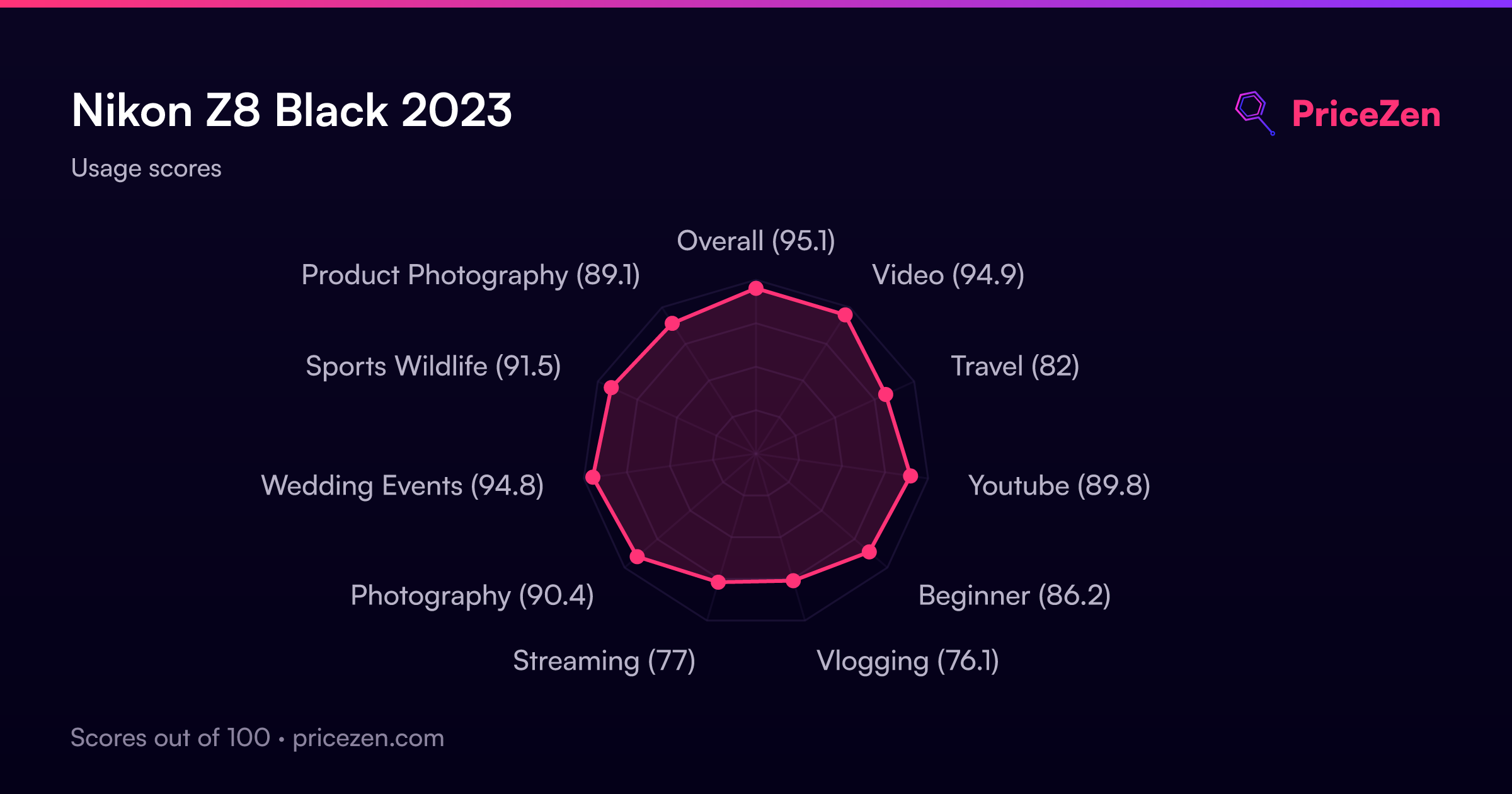
Usage Scores
- Overall95.1
- Video94.9
- Travel82
- Youtube89.8
- Beginner86.2
- Vlogging76.1
- Streaming77
- Photography90.4
- Wedding Events94.8
- Sports Wildlife91.5
- Product Photography89.1